Evaluation Resource Manual
This Manual is a practical guide especially created for early childhood principals, administrators, teachers, and others directly involved in providing appropriate, high-quality preschool and kindergarten programs for young children in both public and nonpublic settings. The purpose of this manual is to inform evaluators and administrators about the North Carolina Teacher Evaluation Process (NCTEP), a component of the North Carolina Educator Evaluation System (NCEES), and how it can be used to promote the professional development and growth of early childhood education professionals. The manual contains procedures for observing and evaluating prekindergarten and teachers in the early grades who hold the North Carolina Birth through Kindergarten Initial (formerly SPI) or Continuing (formerly SPII) License and work in public or nonpublic schools. This manual may also be used by any personnel who have been formally trained in the NCTEP and are preparing to apply the system in early childhood settings. This document is not intended to replace or substitute for any part of the NCTEP rubric in any way.
The Big Picture:
Authors of the Resource Manual for Administrators and Principals Supervising and Evaluating Teachers of Young Children explain,
“The overarching goal of the entire process is to support and scaffold a career long journey of self-discovery and professional growth for each teacher. Just like our goal is to make every young child into a lifelong learner, in love with the process of growing and developing new knowledge and skills, this process is designed to facilitate opportunities for teachers to grow, develop, and model lifelong learning for the children. We can help teachers get excited about this prospect by inviting them to be fully engaged in the process. We can communicate to them that many forms of evidence are needed to paint a complete and holistic picture of their professional practice. As mentors and evaluators, our role is to help them understand the many forms that evidence can take, including child work samples, teaching artifacts, and anecdotes that illustrate child behaviors representative of their growth and development. We also need to emphasize to teachers that artifacts are not the ends in themselves, but rather the means through which they can tell the story of their professional growth and accomplishments, a story that is best told in their own voice. We encourage teachers to collect, reflect about, select, and present their own evidences. The NC Teacher Evaluation Process is a collaborative and participatory process. It is not something that we do to or for teachers; rather it is a process we go through with teachers.”
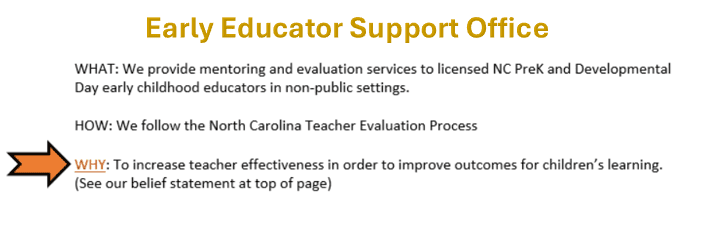
When we understand the big picture, we are able to work from the inside out, realizing that our why, how, and what are identical to that which we support our teachers to understand about their impact in working with children and families. In your day to day support of teachers, it is important to frequently reflect upon your own thinking, your approach, your knowledge and skills, your delivery, your stance, etc. Ask yourself, “Am I modeling what the children deserve?”